

Most of what is written about yacht photoshoots in Miami is written by operators selling you a photographer. This is the other guide: the one for people who already have a crew, a concept and a shot list, and who need to know how a day on the water actually behaves.
A yacht is a genuinely good set. It is also a set that moves, has no mains power, runs on a clock you are paying for, and puts salt in the air around your lenses. None of that is a problem if you plan for it. All of it is a problem at 4pm when the light is perfect and your batteries are not. Everything below assumes a private captained charter from Miami Beach Marina, with a USCG-licensed captain who sets the final route around wind, tide and sea state.
In this guide

The short answer
Book the block that lands golden hour on the water, not the block that is cheapest. Pick the backdrop first and let the captain plan the route around it, because the skyline, Star Island, Stiltsville and the sandbar are in different places and you cannot have all of them in one short charter. Remember that your photographer, assistant and stylist count toward the thirteen-guest limit. And tell us it is a commercial shoot when you book, not on the dock.
Light is the whole shoot
On land you can chase shade. On the water at midday there is none, the sun is directly overhead, and everything you shoot has hard shadows under the brow and a blown-out sky behind it. This is the single most common reason a yacht shoot comes back disappointing.
Two windows actually work.
Golden hour into sunset is the one everybody wants and the one worth building the whole booking around. Biscayne Bay faces the city, so late in the day the sun drops behind the Miami skyline and you get warm side light on faces with the buildings backlit. Book a late-afternoon block that puts you in position roughly an hour before sunset, not one that has you still at the dock.
Early morning is quieter, flatter and badly underused. The water is at its calmest, the bay is almost empty, and you get clean light from the opposite direction. For product, fashion stills or anything where you need the boat to look pristine rather than moody, morning is often the better call.
Midday still has one use: the sandbar. Overhead sun is what makes shallow water read turquoise in camera, so if the shot is water colour rather than faces, noon is right.
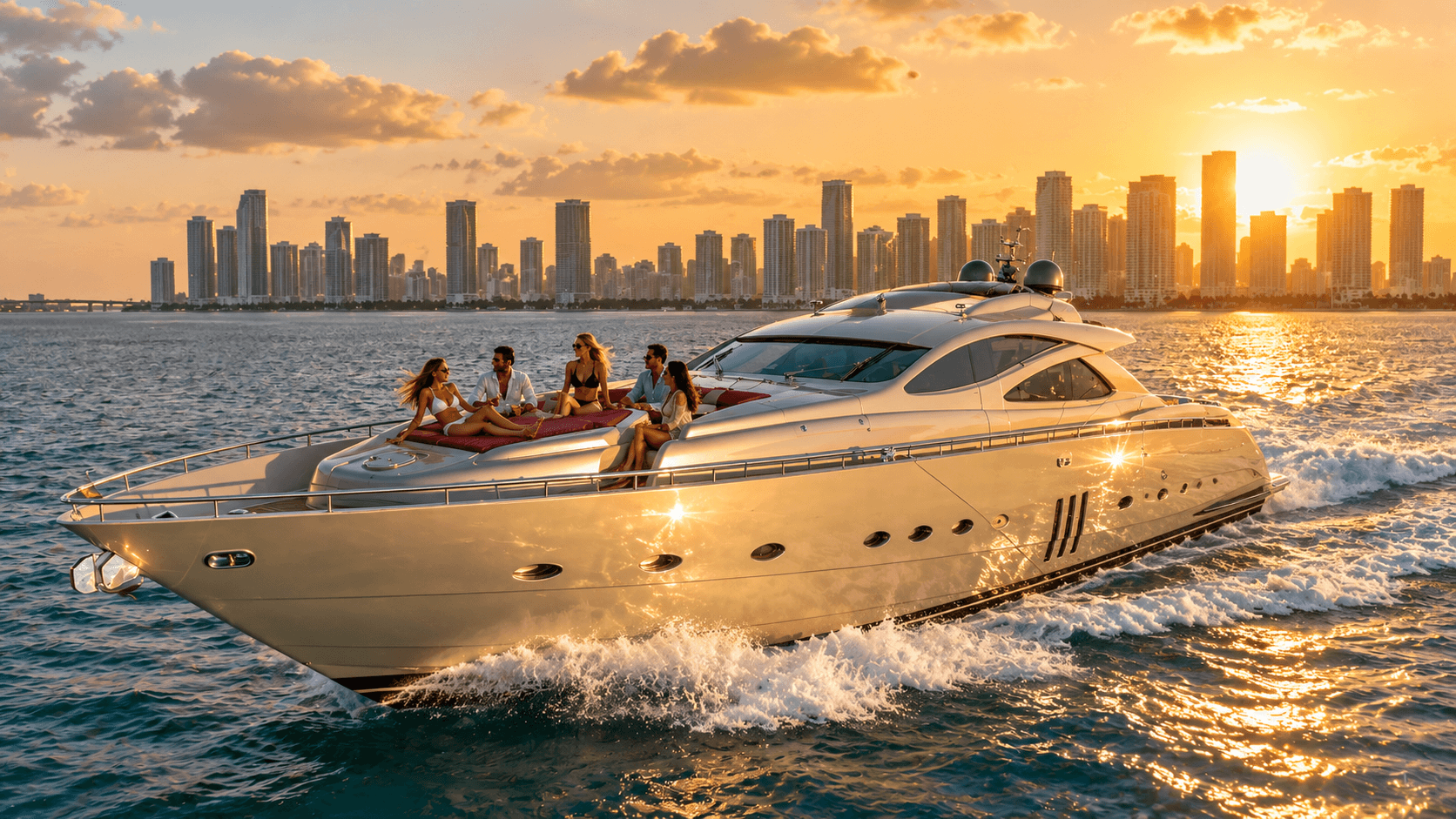
Featured: 90 Pershing Refit 2025
The backdrops, and where each one is
These are not interchangeable and they are not all in the same place. Pick the one the concept needs, tell us, and the captain builds the route around it. Trying to collect all five in a four-hour charter is how you end up with none of them properly.
| Backdrop | The look | Worth knowing |
|---|---|---|
| Downtown and Brickell skyline | Dense vertical city behind the boat, best backlit at sunset | The signature Miami frame, and the reason to shoot late in the day |
| Star Island and the Venetian Islands | Palms, seawalls and waterfront mansions | Close to the marina, so it is cheap in charter time |
| Open ocean past Government Cut | Deep blue, no land, horizon only | Rougher. Great for drama, hard for anything needing a steady deck |
| Stiltsville | Wooden stilt houses standing alone on the flats, nothing like it anywhere | A real run from the marina, so budget the hours for it |
| Haulover or Nixon Sandbar | Shallow turquoise water, people in the water, swim platform level | Busy on weekends. Weekdays give you an empty frame |
If the stilt houses are what you are after, our guide to the Stiltsville and Biscayne Bay day trip covers the run properly. If the shot is the skyline at golden hour, a sunset cruise is the format that already does exactly that.
The boat as a set
Think of the hull as four separate locations, because that is what you are actually buying.
The foredeck is the cleanest of them and usually the best one. Open sky, no clutter, the bow pointing into frame. On sport profiles it sits low and reads sleek; on a flybridge yacht it is higher and more elevated.
The flybridge gives elevation and the skyline over the shoulder, and it is the only spot where you can get a wide group shot with the city in it.
The swim platform is water level. It is the money angle for swimwear and anything that needs the subject in and out of the water, and it is where a low, broad stern earns its keep.
The interior is your weather cover and your styling change. Worth asking what the saloon looks like before you commit, because interiors vary far more between boats than exteriors do.
Scale is a real choice here, and bigger is not automatically better. A 97 San Lorenzo gives you multiple decks, shaded space and genuine superyacht scale when the brief calls for it. A 43 Pardo gives you something quite different: a clean walkaround day boat with a beach-club stern that drops right to water level, which for a small editorial crew is often the better frame. Our full fleet runs from the low forties to 135 feet.
“I have chartered Danny’s 65 Ferretti a couple times and the yacht is incredibly clean. IT LOOKS NEW. Crew is great, they have amazing service.”
– Google review, Mario Galante
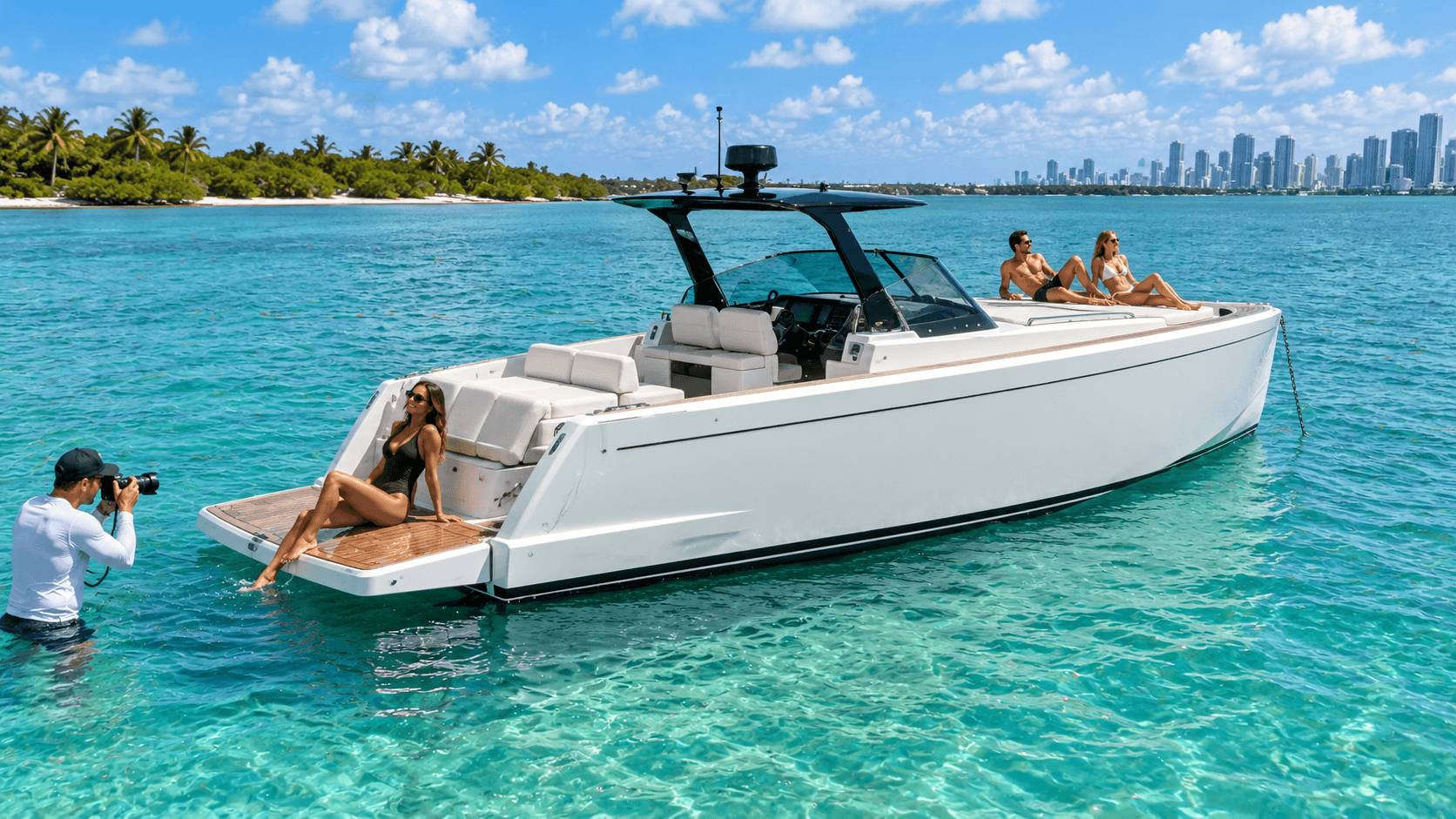
Featured: 43 Pardo 2021
Your crew counts against the thirteen
This is the detail that catches production people more than anything else, and it is worth reading twice.
Private charters are capped at thirteen guests. That is a vessel certification limit, not a house preference, and everyone who steps aboard who is not the vessel’s own captain and crew counts toward it. Your photographer is a guest. So is the assistant, the stylist, the MUA, the client who wants to come and watch, and the friend carrying the reflector.
| Shoot shape | Crew | Talent | Total against the thirteen |
|---|---|---|---|
| Solo creator | 1 (you) | 1 | 2 |
| Small editorial | Photographer, assistant, stylist | 2 models | 5 |
| Branded content | Photographer, videographer, AC, stylist, MUA | 3 talent | 8 |
| Full production with client | 6 crew | 4 talent, 2 client | 12 |
That last row is the one that goes wrong. Twelve is already at the edge, and the client who decides on the morning to bring two colleagues has just made the booking impossible. Give us the real maximum headcount at the first call, including every single person who might come, and confirm it the day before.
Shooting on the water in Miami? Send us your date, your headcount and what the frame needs to look like, and we will come back with two or three real options from the fleet and an all-inclusive quote. No online checkout, just a straight answer from a broker who knows the boats.
Gear, power and what actually fails
Four things catch people out, and all four are solvable the day before.
Power. Do not assume you can plug in. Some boats have accessible outlets under way and some do not, and the ones that do may not run them continuously. Ask which boat has what when you book, and bring enough batteries to shoot the whole block without charging. Assume nothing on the dock either.
Salt and spray. The bow takes spray under way even on a calm day. Lens cloths, a rain cover and a sealed bag for anything not in use. Change lenses below deck or in the lee of the superstructure, never on the foredeck at speed.
Stabilization. A yacht at anchor still moves. A gimbal that is fine on land will fight a rolling deck, and long lenses are brutal. Shoot wider than you think, raise your shutter speed, and get your locked-off shots at anchor rather than under way.
Audio. Wind noise is the thing nobody budgets for. Open deck at ten knots will destroy dialogue. If the piece has sync sound, plan to record it at anchor with proper wind protection, or plan to replace it.
One more practical point: everything you bring, you carry down a dock and up a passerelle, and then back again. Hard cases are heavy and awkward on a boat. Pack lighter than a land shoot.
Drone footage, honestly
Aerials are what make yacht content look like yacht content, and this is the part most operator pages gloss over.
The practical side is straightforward. The captain can position the boat for the shot, hold a heading, and run a pass for you. Launching and recovering a drone from a moving boat is the hard part, so plan to do it from the foredeck or the swim platform with the boat stopped, and have a second person on the catch.
The regulatory side is yours, not ours, and it is not something to improvise. Miami has busy and restricted airspace, commercial drone work has its own licensing requirements, and conditions over water change fast. Bring your own properly licensed operator, check the airspace for your actual route before the day, and tell us in advance that you plan to fly so the captain can plan around it. We will say yes or no honestly rather than leaving you to find out at the dock.
Commercial use, the yacht name and releases
These are privately owned yachts, not a studio backlot, and owners have views about how their boat appears in commercial work.
In practice this is simple if you raise it early and awkward if you do not. Tell us at the enquiry stage that the shoot is commercial, what it is for, and whether the vessel will be identifiable. Some owners are relaxed, some want the yacht’s name kept out of frame, and some will not allow their boat in certain categories of advertising at all. Finding out which applies takes one phone call before you book and is impossible to fix on the morning.
The crew are people too. Shoot the boat and your own group freely, but if a crew member will be recognisable in a commercial piece, ask them, the same as you would anywhere else.
Catering, transport to the marina, extra hours and anything else the day needs are arranged alongside the charter, and our charter services page covers what can be added. For a production, the two worth asking about early are extra time and a second tender for chase-boat angles.
And the obvious one: the captain runs the vessel and has the final word on anything involving safety. If a shot needs someone on the bow under way, or hanging off the platform, or the boat stopped in a shipping lane, the answer may be no. Flag ambitious setups when you book rather than negotiating them on the water.
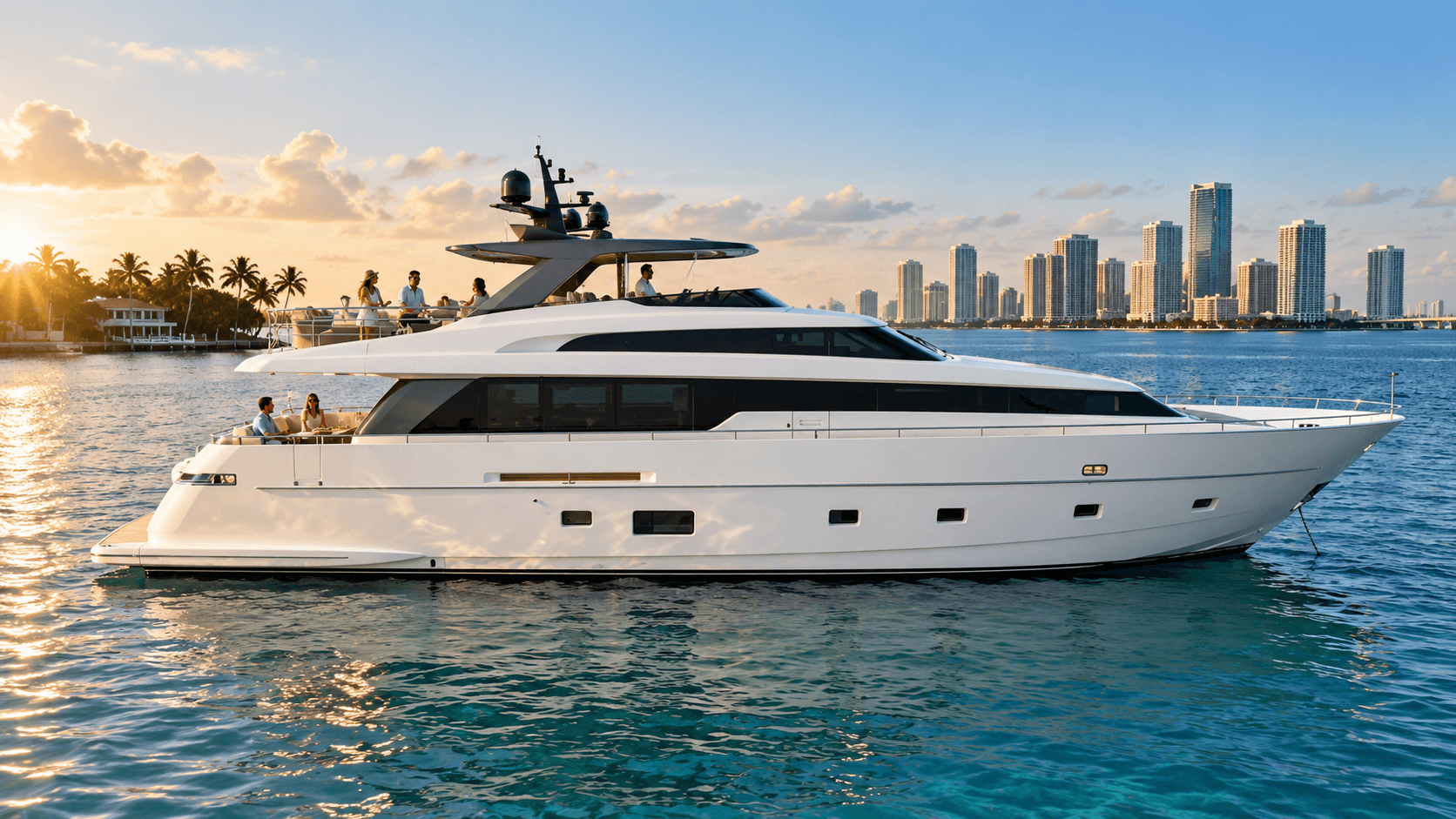
Featured: 97 San Lorenzo
A realistic shoot-day schedule
Built backwards from sunset, on a six-hour block. Adjust for your own call times, but the shape holds.
| Clock | What is happening |
|---|---|
| 60 min before departure | Crew and gear arrive at the marina. Load, set up, brief the captain on the shot list |
| Departure | Clock starts. Slow run through the no-wake zone. Shoot interiors and detail here |
| First 45 min | Star Island and the Venetian Islands. Cheap in time, good for establishing and movement |
| Midblock | Anchor. The locked-off work, swim platform setups, anything needing a still deck |
| 90 min before sunset | Reposition for the skyline. This is the shot you booked the day for |
| Golden hour | Shoot it. Everything else was preparation |
| Last 30 min | Run back in. Do not plan a setup here, the light is gone and so is the crew |
Two scheduling notes that cost people real money. The clock starts at the booked departure time, not when your last crew member parks, so arrive early. And four hours sounds like plenty until you subtract boarding, the no-wake zone and the run home, which leaves you well under three hours of actual shooting. For anything beyond a single simple setup, book six.
Season matters too. November through April gives you reliable light and calm mornings but books out fastest on weekends. Summer is quieter and cheaper, with the caveat that afternoon storms build from June through September, so morning blocks are safer. Our guide to the best time to rent a yacht in Miami breaks the year down, and the charter tips guide covers the general day-of practicalities.
Frequently asked questions
Can I rent a yacht in Miami just for a photoshoot?
Yes. A photoshoot or video shoot is simply a private charter with a different purpose, and the format is the same: you book the boat and a USCG-licensed captain for a block of hours. Tell us it is a shoot when you enquire so we can match the boat to the frame and flag anything the owner needs to approve.
What time of day is best for a yacht photoshoot in Miami?
Late afternoon into golden hour for anything with people in it, because Biscayne Bay faces the city and the sun drops behind the skyline. Early morning for calm water and clean light. Midday only if the shot is turquoise water at a sandbar.
Do my photographer and crew count toward the guest limit?
Yes. Private charters are capped at thirteen guests and everyone aboard who is not the vessel’s own crew counts, including your photographer, assistants, stylist and any client attending. Give us the full number at the first call.
Can we fly a drone from the yacht?
Practically, yes, and the captain can position the boat for the shot. The licensing and airspace side is your responsibility. Bring a properly licensed operator, check the airspace for your route beforehand, and tell us in advance so the captain can plan for it.
How long should I book for a shoot?
Six hours for anything with more than one setup. Four hours leaves you under three hours of real shooting once you account for boarding, the no-wake zone and the run back. If you need two distinct locations plus golden hour, book eight.
Is there power on board for charging?
It varies boat to boat, so ask rather than assume. Plan to shoot the whole block on batteries and treat any onboard power as a bonus.
Can we use the footage commercially?
Usually, but it depends on the owner and it has to be agreed before you book. Tell us at the enquiry stage that the shoot is commercial and whether the yacht will be identifiable. Some owners prefer the vessel’s name stays out of frame.
Which yacht is best for a shoot?
It depends entirely on the frame. A sport profile reads sleek and dramatic, a superyacht gives you multiple decks and scale, and a compact walkaround with a beach-club stern is often the strongest look for small editorial work. Tell us the concept and we will shortlist.
Miami Beach Marina · Captained charters
Tell us what the frame needs
Send the date, the crew and talent count, and the look you are after, and we will shortlist the boats that give you that deck, that profile and that light. No listings to sift through and no online checkout, just a real conversation with a broker who knows the fleet.
Quote back the same day · All-inclusive pricing, itemized before you commit · Professional captain and crew on every charter · 50+ yachts, 40 ft to 135 ft · Departures from Miami Beach Marina
“I had an exceptional experience with this yacht rental company. The yacht was immaculate, the crew was professional, and the overall service exceeded my expectations. A perfect choice for a luxurious and memorable sailing adventure. Highly recommend!”
Gustavo Jose, Google review
Pick your yacht
Every boat below is part of the MYC Exclusive fleet. Prices shown are starting rates, and your final all-inclusive quote depends on the date, the season and the add-ons. Tap any yacht for full specs, or call 305-813-0537 and we will shortlist for you.

112 Custom Privilege
Prices starting at: $9,200

116 Azimut
Prices starting at: $10,500

166 Trinity
Prices starting at: $30,000

70 Aicon
Pricing starting at: $3,200

66 Marquis
Prices starting at: $3,100

66 Azimut
Prices starting at: $5,500

68 Galeon 2025
Prices starting at: $4,500

105 Azimut Biabeca
Prices starting at: $12,100

88 Sunseeker Flybridge
Prices starting at: $3,800


